Friday, April 3, 2015

Liyuan Garden

Situated at Genghua Village Tangkou Town, Kaiping District of Guangdong Province, Liyuan garden is a private garden on the shore of Li Lake. Built in 1936, Liyuan Garden is one of the four most famous gardens of Guangdong Province. Named after its master, Xie Weili, an overseas compatriot, the garden is a notable example of the private gardens constructed by overseas Chinese. Covering an area of 1.1 hectares (2.72 acres), it is situated in Tangkou Town, Kaiping City. The garden is a first-rate garden combining the lingering charms of China and the occident.
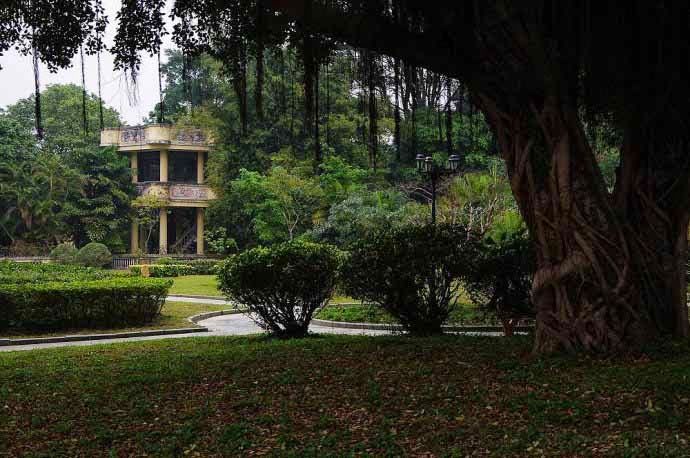
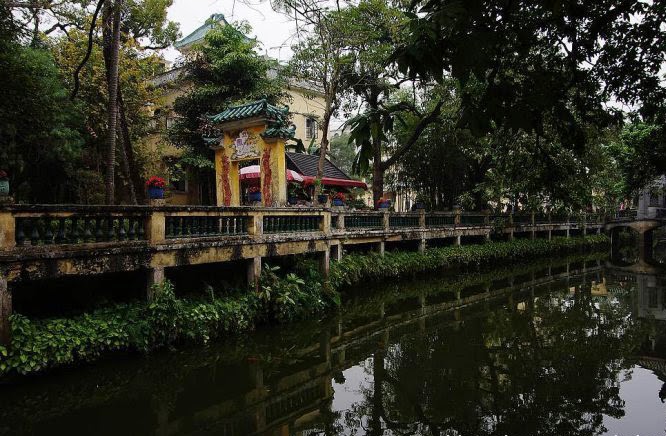
This unique garden is a perfect combination of the modernist western architectural style of the period and the traditional landscaping of China. The distinctive characteristics make this elegant garden a pearl among Chinese gardens. A special feature of the garden is the wide and deep canals which string together the architectural features of the garden. Above the canals, there are winding corridors, fine bridges and exquisite pavilions. The layout of the garden can be delimited into the Villa Zone, Grand Garden and Little Garden.
Entering the garden from the frontispiece and walking along the art corridor, you will find the Villa Zone, which contains six villas and an ancient watchtower. Covered with double-tier roofs and green glaze tiles, the Panwenlou Villa and the Panlilou Villa are the two most magnificent villas. Italian building materials are used for flooring and the staircase, and the walls are decorated with grand frescos, delicate embossments and lifelike metal-coated woodcarvings. Adorned with western fireplaces and artistic ancient lamps, the rooms look more elegant with elaborate blackwood furniture inside. A bronze statue of the garden's master stands in front of the Panlilou Villa.
The Grand Garden Zone lies to the west of the Villa Zone and comprises several extraordinary buildings. The majestic Memorial Archway was built in 1926-1936, and has a width of 37.7 feet and a height of 36 feet. Closely behind the Memorial Archway is a stately Decorated Archway which is roofed with green glazed tiles. It consists of a main building 21.3 feet high and two accessory buildings which are 16.4 feet high. To the east of the Decorated Archway, there stands a unique structure called the Bird's Nest. The top is built in ancient Roman style while the middle part looks more like the Chinese paper cutting. Inside the Bird's Nest, there is a pond and rockwork populated with peacocks and other birds. The elegant Hua Teng (Flower Vine) Pavilion is a closed structure built with numerous grilles and the roof is shaped like the crown of the Queen of England. The Yupei Villa is a tower dwelling located in the southwest of the Garden Zone. The four-storey construction shows high architectural skill, blending Chinese, Japanese, Italian and ancient Roman styles.
Connected with the Villa Zone by canals, the Little Garden Zone is characterized by fancy bridges and bijou pavilions, including Kuahong Bridge, Wanxiang Pavilion, Chanchun Pavilion and Guanlan Bridge. The hexagonal Yicui Pavilion is engraved with a golden dragon and vivid designs of the Eight Immortals in the inner roof. Excellent couplets written by luminaries are scattered across the buildings, and they add a cultured air to the beautiful Liyuan Garden.
Each part of the garden has a style of its own. They are separated by water or walls, but are connected by pavilion bridges and winding corridors, which can provide much food for thought for their views within the view and gardens within the garden. Moreover the couplets hung on the pillar and written by famous calligraphers make the garden rich in cultural connotation. Plenty of romantic and elegant clay carvings and printed murals make you feel that you are staying in a Fairyland. The scenery of the garden is so attractive that it draws a number of photographers towards it.
For more information, please visit www.top-chinatour.com

Thursday, April 2, 2015

Guifeng Mountain National Forest Park

Guifeng Mountain is situated in Xinhui District and this famous scenic spot has elevated to a national forest park and ranks as one of the famous tourist zones in Guangdong. Guifeng Mountain National Forest Park is the southest national forest park in China. Relying on its advantageous natural resources, the lofty peaks and verdant forest give it endless vigor and charm. The special geographical location makes the mountain a rare pearl of South China. Being a notable scenic spot, the mountain also has several historical relics and has been home to many celebrated ancient scholars and venerable Buddhist followers.
With forest coverage of more than 90 percent, Guifeng Mountain has an elevation of 437 meters (1,433 feet). Covering an area of 5,510 hectares (13,616 acres), it bears the vast forest, rare plants and exotic flowers. The red autumn leaves on the mountain are comparable to those of the Fragrant Hills Park of Beijing for there are extensive areas of trident maple trees. As deep autumn advances, the mountain is covered with scarlet leaves and the magnificent view attracts admiring crowds. The rich natural resources of the national forest park provide excellent resting places for numerous animals and birds, including some rare species. The main spots in the park are the following.
Yutai Temple
Yutai Temple is one of the four most famous temples of Guangdong. It was built in the Eastern Han Dynasty (25-220) and reached its heyday in the Tang Dynasty (618-907). The sublime temple has many imposing Buddhist structures, including the Hall of Heavenly Kings, Bell Tower, Drum Tower, Hall of Great Hero, Sutra Depository, Kwan-yin Hall and Zendo. The Tianwang (Heavenly King) Pagoda, built during the Yuan Dynasty (1271-1368), is the only Lama pagoda of Guangdong Province. Ruquan (Milk Spring) Well is a miracle of the Guifeng Mountain and you can find it not far from the Yutai Temple. The constant spring is cool and sweet, and it is a mystery that the ivory-white water has the taste of milk, which is especially obvious in winter.
Jade Lake
The Jade Lake is the main tourist resort and a place of recreation. A delicately elegant pavilion, which resembles a blooming flower, lies in the center of the lake. There are arch bridges among the rockworks in the lake, and tourists can swim and boat in the lake or have a walk along the banks to appreciate the picturesque scenery. The lake becomes especially charming at night with sparkling bonfires and colorful shining lights. The national forest park also has a well-equipped sports park on a grand scale, providing ice-skating, rowing, grass-skiing, rock-climbing, go-karting and other popular sports, as well as barbecues.
Other attractions like Bixia Mansion, Zhenshan Temple, Premier Zhou Memorial are also worth visiting. There is also a grass-skating field here for people who like grass-skating and other Entertainment facilities for tourists.
For more information, please visit www.top-chinatour.com

Wednesday, April 1, 2015

Xinfengjiang National Forest Park

Xinfengjiang National Forest Park, also known as Wanlv Lake (Evergreen Lake), it is the largest eco-tourism attraction in South China's. Situated in Dongyuan County of Heyuan City, there are more than 360 Green Island. Subtropical forests cover more than 78 percent of the park. Xinfengjiang National Forest Park is built relying on the largest man-made lake in South China, the Evergreen Lake. Backed by the Laurel Mountain (Guishan Mountain), the zenith of the city, this scenic area also holds hundreds of green islets dotted on the lake. 

The forest park covers an area of 160,000 hectares (395368.6 acres) in total with water areas of 37,000 hectares (91,429 acres). The geographic environment of the park is richly endowed by nature. In the vast virgin forest lives much subtropical evergreen broad-leaved vegetation, some rare plants, about 130 species of animals and 110 kinds of birds. With its great variety of flora and fauna, the forest park is known as 'Kingdom of Flora' and 'Paradise of Fauna'.
The Laurel Mountain (Guishan Mountain) of the forest park has a pleasant climate and unspoilt natural beauty and marvelous mountain splendor. The fresh air and the favorable environment make the mountain a natural oxygen bar. There are cloud-kissing ancient trees, delicate pavilions, murmuring brooks, an iron chain bridge, fields of wild flowers, and over 20 charming waterfalls in the mountain. An extensive area of wild azaleas grows on the main peak of the mountain which has an elevation of 1,056 meters (3,465 feet). In April and May, the mountain top is covered by colorful blooming flowers.
 
In the forest park, there is a long stream with rare stones scattered throughout the water and unique pavilions standing along the bank. Flowers, both wild and cultivated, form a wide belt of natural beauty on the banks, making the stream a delightful attraction. Tourists to the forest park can entertain themselves by participating in such activities as aquatic disco, playing in the water, drifting, swimming, climbing, hiking, and exploring the natural beauty of the area.
For more information, please visit www.top-chinatour.com

Tuesday, March 31, 2015

Sujiawei Hakka Village

Heyuan City, a tourism city situated in the northeast of Guangdong, is best known for its beautiful natural scenery and Hakka culture.  Among the attractions there, Sujiawei Hakka Village is a must for tourists who are interested in the Hakka culture and customs. It is a picturesque village featuring Hakka culture and ancient dwellings. The village is also famous for the residence of the descendants of Su Dongpo, a great writer, calligrapher and painter of the Northern Song Dynasty (960-1127).
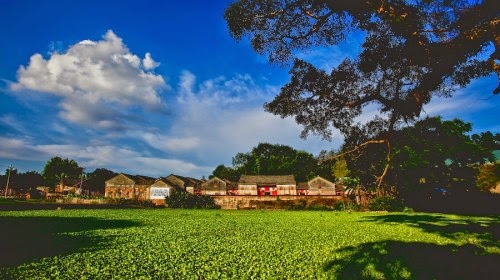
The enchanting rivers, lush bamboo trees, gigantic banyan trees, ancient buildings, fishing boats and distinctive waterwheels contribute to the beauty of the village, while the rich culture also adds charm to it. Sauntering in the enchanting village, you will easily drink in the centuries-old culture of the Sui Family, and the antiquity and simplicity of the Hakka people.
Yingqin Bridge
Yingqin (Welcoming Tourists) Bridge, a must seen spot of the village, represents the hospitality of the inhabitants towards their visitors. Standing on the bridge you can see the whole village, a group of square buildings in Ming (1368-1644) and Qing Dynasties' (1644-1911) style. The perfect drainage system of the constructions made the village survive heavy rainfall.
Hakka Marital Customs
Teasing the bride on her wedding night is a typical marital custom of the Hakka Village. Showing the tradition of horseplay in the bridal chamber, it is a popular performance among the tourists. The Hakka matchmaker invites one of the tourists to act as the bridegroom while the others are amused by the interesting and funny performances.
Hakka Round-Dragon House
The Round-Dragon House is a typical Hakka residence with the architectural characteristics of Central China. The Round-Dragon Houses of Suijiawei Village resemble a grand circle. In the past, to withstand the unfriendly intruders, the Hakka people lived together and constructed their houses in the style of a castle.
Yongsi Memorial Hall
The oldest house, called the Yongsi Memorial Hall, was built in 1481 in memory of Su Dongshan, the eighth-generation descendant of Su Dongpo and as a place for the villagers to worship their ancestors and discuss important affairs.
Su Ancestral Memorial Hall
The Su Ancestral Memorial Hall, with a history of over 470 years, once had an array of significant cultural relics of the Su Family. The existing plaques, which were given by the emperors, provide an idea of the past glory and resplendence of the Sujiawei Village. More than 100 title deeds of the Ming and Qing Dynasties kept in the memorial hall witnessed the richness of the village. The burning of incense before the memorial tablets reflects the adoration of descendants of the Su Family towards their honorable ancestors.
After visiting the ancient houses, visitors can take a walk along the Dongjiang River and enjoy the Hakka folk music under the huge banyan trees at the riverside. They can also have a chance to experience traditional Hakka wedding customs in the Sujiawei wedding performance theater.
For more information, please visit www.top-chinatour.com

Sunday, March 29, 2015

Qinghui Garden

As one of the four major gardens in the Qing Dynasty of Guangdong, Qinghui Garden has been listed as cultural relics of provincial importance. Situated in Daliang Town, Shunde District of Foshan City, the spectacular Qinghui Garden ranked among the top ten gardens of China. It was first constructed under the direction of a most successful landscape advisor to the late Ming Dynasty (1368-1644) and has undergone regular elaborate enhancements over the past hundreds of years.
Qinghui Garden used to be the mansion house of Huang Shijun, a Zhuangyuan (No. 1 Scholar in the highest imperial examination) in the Ming Dynasty, and was later purchased by Long Yingshi, a Jinshi (a successful candidate in the highest imperial examination) in the Qing Dynasty. It is with the detailed and careful construction of generations of the Long family that the Qinghui Garden assumed, roughly though, its present layout. Recent years have witnessed extensive renovations and expansion to the Garden, the area of which has been extended to cover over 22,000 sqare meters.
Qinghui Garden enjoys exquisite architectural design. With gardens, pavilions, verandas and natural landscape densely and harmoniously arranged together, each step through the garden reveals new sceneries. The artistic arrangement of the natural landscape includes garden rockery, zigzag streams, flora like gingko and Longan trees. Besides natural landscape, the Garden is also adorned with refined works of arts like pieces of pottery and porcelain, wood carvings, glass etching, and time-honored Chinese couplets. Whether you are wandering on the zigzag bridges and watching fish swim playfully, or walking through the corridors and enjoying the fragrance of trees and flowers, you can indulge yourself in this peaceful and relaxing atmosphere.
Absorbing the cultures of both the Ming and Qing Dynasties, incorporating the architectural characteristics of ancient garden design in both Lingnan (area covering Guangdong and Guangxi provinces) and Jiangnan (area south of the lower reaches of the Yangtze River) areas, plus a touch of the Pearl River Delta flavor, the Qinghui Garden has now developed into a picturesque garden of great attraction.
For more information, please visit www.top-chinatour.com

Ancient Nanfeng Kiln-----Ceramic Capital in south China

Brief introduction
Ancient Nanfeng Kiln is a tourist attraction in the Ancient Nanfeng Kiln Cultural and Creative Zone, which is located in Shiwan Town, Chancheng District, Foshan city. It is the oldest kiln of China and where the pottery art of Foshan originated, the history of the kiln can be traced back to the Ming Dynasty (1368-1644). It is amazing that this ancient kiln still operates. Visitors can enjoy an ever fascinating experience to make their own pottery in this fascinating national treasure.
History
According to the historical record, Foshan Pottery Base formed in Tang and Song Dynasties and popularized in Ming and Qing Dynasties. The Dragon Kiln played a main role among the kilns of Shiwan Town. Such a kiln is always built against a hill and winds its way along the slope, resembling a gigantic dragon. Now the Nanfeng Ancient Kiln is the most ancient one of three existing Dragon Kilns. Interestingly, visitors who come here can make pottery by themselves when visiting the working procedures of making pottery in Nanfeng Ancient Kiln.
Features
Thanks to its long history, Foshan is largely glorified. Although production has never stopped, the antique kiln is well preserved. It is indeed rarely seen in China or the rest of the world, and the kiln is considered as a 'live cultural relic'. The mouth of the ancient Nanfeng Kiln faces south and the giant banyan trees make a pleasant shade at the end of the kiln. In summer, there is always good breeze; therefore, the kiln gets its name 'Nanfeng' which means south wind. It is really a wonder that the over 400-year-old banyan tree can survive in such high temperature and infertile land.
What can do here
Tourists can experience the real process of making pottery. When timbers are put into the kiln, the burning kiln looks like a firedrake falling from heaven and the temperature can reach to 1,300 (2,372 F). In the Nanfeng Kiln, the traditional pottery making techniques live on. Temperature control is practiced by the skilled workmen according to their experience instead of modern apparatus. It is astonishing that each piece of pottery made is unique even if they come from the kiln at the same time. The instability of temperature of the wood-burning kiln brings in the variety of the products and some of them are rare and precious.
Besides, tourists to the kiln can make pottery by themselves with the assistance of professional workers. You can choose desired types and design distinctive patterns, making it a unique household decoration. If you want to buy some souvenirs, the pottery of Shiwan Town should not be missed.
For more information, please visit www.top-chinatour.com

Saturday, March 28, 2015

Bruce Lee Ancestor's House

Bruce Lee Ancestor's House has been a scenic spot for his fanatic fans and martial arts lovers. As an outstanding Chinese Kung Fu master and action movie star, Bruce Lee contributed greatly to promote Chinese martial arts and Kung Fu films. Although he lived a short life for only 30 years, his radiance of glory overshadows any other Chinese Kung Fu stars of his time. Even Jackie Chan and Jet Lee's hey days nowadays cannot match his achievements. From 1972 to 1973, Bruce was consecutively acquired the fame as one of the seven great martial arts masters in the world by the international authoritative martial arts magazine "Black Belt". At the turn of the new millennium, he was nominated as one of the most infusive idols in the 20th century, the only one in China. Bruce Lee has become the spokesman of Chinese "Kung Fu" for numerous foreign friends. 
Located in Shang Village, Shunde District, Bruce Lee Ancestor's House is about 60 kilometers (about 37 miles) away from Guangzhou City. At the entrance of Shang Village stands the Lee's Ancestral Hall. It was built to immortalize Lee's ancestors. The Ancestral Hall is very grand, spacious and solemn. Bruce Lee's Ancestor's House is near the Lee's Ancestral Hall. It was built by Bruce Lee's grandfather. Bruce's father also lived here. Bruce lived here only for a short period. He spent the most part of his childhood and teen years in Hong Kong.
Bruce Lee Ancestor's House is a typical folk residence made of brick and wood in the Pearl River Delta. It is composed of a bedroom, a hall, a kitchen and a dooryard, encompassing an area of about 51 sq meters (about 61 sq yards). It is a very humble house, and the furnishings are very simple. On the walls of the hall hang a brief introduction about the life experience of Bruce Lee, and several large stills from his films, in which Bruce Lee played the leading roles. At the hall, there is a wooden stake and an incense burner table. The wooden stake is used for practicing Kung Fu. The incense burner is used to make sacrifices to Lee's ancestors. The dooryard covering an area of about 20 sq meters (about 24 sq yards) is a good place for practicing Kung Fu.
In order to pay tribute to Bruce Lee for his contribution to the promotion of Chinese martial arts, a memorial museum was built and completed in 2002. It is located in Daliang Street, Shunde District. Since the memorial museum is situated in an inconspicuous part of the street, it is unfamiliar to the public. Therefore, a new memorial museum has been constructing since the end of 2006, which is situated in Jun'an Town, and is expected to be the largest memorial museum dedicated to the memory of Bruce Lee.
For more information, please visit www.top-chinatour.com